
|
|
 |
 |
 |
 |
 |
 |
 |
 |

| |||||||||||||||||
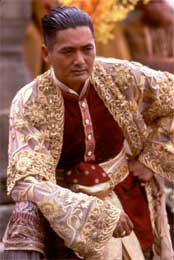
Chow Yun Fat |
Is Leading Man in "Anna and the King"
Click for Highlights of AC Team's Interview with Chow Yun-Fat
A winner of numerous acting awards, Chow Yun Fat (King Mongkut) has made a career of versatility, being equally at home in action thrillers, slapstick comedies and tragic dramas.
In the late 1950s, Chow spent his childhood in a fishing village on Lamma
Island in Hong Kong. He moved to the city when he was ten years old, and at the age of 17 quit school to work at odd jobs. At the urging of a friend, he enrolled in an actor's training course at TVB - Hong Kong's most powerful television station. A year later, he graduated and signed with TVB as a contract player. Chow's charisma and acting ability propelled him to leading man status in
just a few short years. In 1976, Chow starred in the 128-episode drama series "Hotel," which made him a top television star and a household name in his native Hong Kong. In 1981, Chow created another craze with the series, "The Bund," in which he played a gangster in 1930s Shanghai. This time he became a household name in every Southeast Asian country.
Chow started making feature films in 1977, and has starred in over seventy films. His big break came in 1981 when "new wave" director Ann Hui teamed with him in "The Story of Woo Viet." At that time, cheap kung-fu pictures were flooding and destroying the market. "The Story of Woo Viet" became a milestone in Hong Kong's cinema history because it was the first "serious" film to be both a critical and commercial success.
|
In 1986 he made twelve pictures, a record for a leading actor. One of these was John Woo's "A Better Tomorrow," which made cinema history: It not only broke all box-office records in Hong Kong, Taiwan, Singapore, Malaysia, Thailand, Indonesia, South Korea and Chinatowns all over the world, it also made a superstar out of Chow. It garnered him his first Best Actor Award at the Hong Kong Academy Awards, but more importantly, he created a phenomenon unseen before in Asia. Audiences everywhere cheered whenever Chow appeared on the screen. Young men began wearing the same dark glasses and long overcoats as his character did in the film. To them, Chow was a hero, and also their pal.
| |||||||||
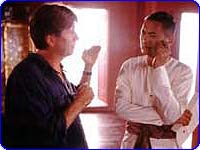
In February 1990, the Art Institute of Chicago mounted a Chow Yun-Fat retrospective, at which he also made a personal appearance. The same retrospective was also picked up by the Asia Society in New York and the American Film Institute in Washington, D.C. It was the first time Chow received recognition outside of Asia.
Other Chow hits include Wong Jing's "God of Gamblers," "Rain Man" (and its sequel), "Witch From Nepal," "The Eighth Happiness," "Tiger on Beat" and "Treasure Hunt," which has been announced for a Hollywood remake starring Chow himself.
In 1993, Chow allowed his last long-term contract in the Hong Kong film industry to lapse. His last Chinese-language film to date was 1995's "Peace Hotel," produced by John Woo and underwritten by the government of Mainland China.
For the American cinema, Chow starred in "The Corrupter" with Mark Wahlberg, and "The Replacement Killers" with Mira Sorvino.
Chow will next be seen in Ang Lee's "Crouching Tiger, Hidden Dragon."
--
20th Century FoxChow Yun-Fat leaves his hand prints in LA's Chinatown
More on the film at http://www.foxmovies.com
Please Read Our Disclaimers and Legal Information.
We welcome your comments. Send e-mail to us at info@asianconnections. com
Copyright ?998-2000 AsianConnections.com